
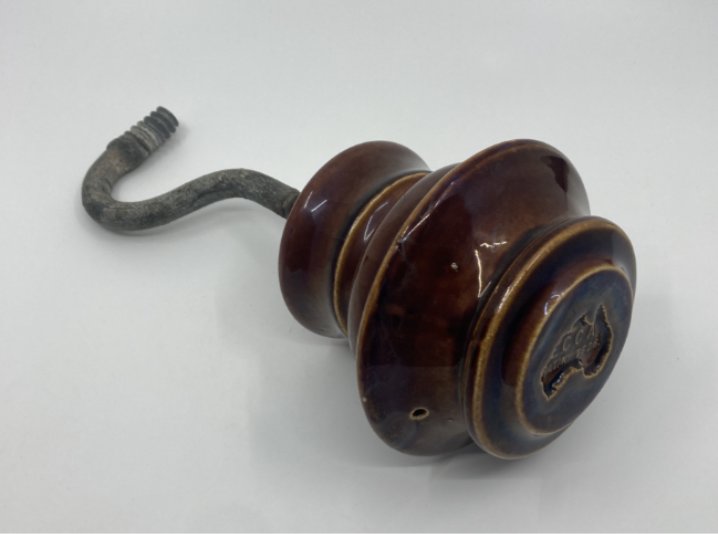
These Aboriginal tools, made of ceramic telegraph insulators, were collected from Camooweal, Queensland. These First Nations tools are scrapers, carefully shaped through a combination of pressure flaking and percussive techniques and designed to utilise the sharpness of the ceramic edges. Ceramic was not the only colonial material to be repurposed with glass also being a popular material for creating tools (Ulm et al. 111). It has been posited that ceramic scrapers such as these were used in woodworking and plant processing (Ulm et al. 111).

This scraper was likely made after 1890 when the telegraph line, and the accompanying ceramic insulators, were installed at Camooweal. Alternatively, they could have been made elsewhere and brought to the inland community. The insulators were obtained by throwing a rock to break the insulator or in some instances by climbing a telegraph pole to retrieve them.

This would disrupt telecommunication and cost the government to replace them, so methods to dissuade the practice began to be put in place. The maintenance workers charged with replacing the insulators began to pre-empt the damage. They would leave pieces of broken insulators that they accumulated in their line of work at the bottom of telegraph poles, knowing they would be used before any damage was done to the line.

A more dramatic response saw the criminalisation of breaking an insulator. This targeted both First Nations people who were repurposing them but also the bored citizens, who would damage them for sport. In 1907 a bounty was placed on people found breaking the telegraph insulators. Civilians were granted the full power of the law to bring the vandal into a police station and receive a 2-pound reward. The offender could then receive 3 years imprisonment. This harsh punishment is a testament to how valuable this ceramic was as a resource for the colony and for First Nations people.
There are many examples within the archeological record as well as written and oral histories of this adapted use of ceramic and glass across Australia. This object highlights First Nations people’s ingenuity as they repurposed this colonial object into a First Nations technology.
See these remarkable cerarmic tools and other fascinating objects in Fragile and Forever: Ceramics from the Queensland Museum Collection, a free exhibition at Queensland Museum Kurilpa in Brisbane.
Reference
“Telegraph Insulators.” Mudgee Guardian and North-Western Representative (NSW : 1890 – 1954) 7 October 1907: 2. Web. 7 May 2026 <http://nla.gov.au/nla.news-article157619507>.
“Traffic Suspended.” The Argus (Melbourne, Vic. : 1848 – 1957) 22 July 1932: 6. Web. 7 May 2026 <http://nla.gov.au/nla.news-article4464247>.
Ulm, Sean, et al. “Historical continuities in Aboriginal land-use at Bustard Bay, Queensland: results of use-wear and residue analysis of Aboriginal glass artifacts.” Australaisian Historical Archaeology, 27, 2009, 111-119


You must be logged in to post a comment.