
Written by Tess Shingles and Dr Geraldine Mate
Historical archaeologists in Australia are experts in British ceramics. This statement, at face value, seems absurd. And yet it reflects the very real historical context of life in Australia from the earliest days of colonisation. The British pottery industry supplied a large proportion of everyday domestic ware to Queensland (and indeed Australia) from the earliest settlements, continuing to supply mass produced ceramics to Australian markets throughout in the 19th century and into the 20th century. Migrant populations from Britain had a ceramic tradition embedded in their everyday life as one of the trappings of “civilisation”. This influenced consumer to participate in the market for British ceramics, particularly those from the Staffordshire potteries in Britain.
This market supply from the UK didn’t occur in isolation, or only as a result of British migration. In the 18th and 19th century in Britain there was a “Ceramic revolution” in the pottery industry, influenced by both the upscale in manufacturing and burgeoning consumption of ceramics at that time. This revolution led to the growth of the industry with industrial-scale processes for mass producing ceramics, and an attendant increase in the numbers of factories, a larger workforce and growing range of products. With this flood of products, the potteries of England were able to make cheaper products, increasing their market to the middle and lower classes in the market. It also meant these businesses pursued markets further afield, to Europe, the Americas and colonial Australia.
So, what did the potteries of central England look like? The Staffordshire Potteries were established in Stoke-on-Trent from the amalgamation of 6 different towns: Tunstall, Burslem, Hanley, Stoke, Fenton and Longton. These towns were located on land that was rich in natural resources required for pottery making and developed their own industries and became collectively known as “The Potteries”.

The influence the Staffordshire potteries have had on the global ceramic market cannot be underestimated. They produced small batch high quality ceramics as well and mass-produced items that catered for global markets. It was the birthplace of names that have now become synonymous with the industry like Josiah Wedgwood and Royal Doulton. The products produced in these potteries ran the gamut of ceramics from earthenware, stoneware, porcelain, and sanitary ware.
By 1800 the potteries employed 15 000 to 20 000 people. Workers were paid relatively decent wages for the time however like most industries coming of age during the Industrial Revolution, the conditions for workers could be hazardous. Workers were exposed to diseases like “Potter’s rot” – a lung disease that would lower their life expectancy and some potteries employed children as cheap labour.
In this market, one of the most enduring product ranges was born. Willow pattern was created as a British-produced product that met the appetite of consumers for Chinese-themed domestic wares. And the Staffordshire potteries are regarded as the pattern’s birthplace. Appropriated from the Chinese ceramics that were so popular with English markets, the blue and white pattern would usually feature a willow as well as boats, birds, bridges and pagodas in a chinoiserie style that represented a story of ill-fated lovers. This plate design is credited to Thomas Minton around 1780 while he was still an apprentice. He would go on to be famous Minton ware.

Together with responding to consumer taste and fashions, another reason that the potteries were so successful was their ability of their designs to appeal to an international market. Mass produced wares were often cheap and utilitarian, with minimal or lower quality decorations, making them highly accessible. This made a global transport and supply network feasible and also responded to far-flung communities.
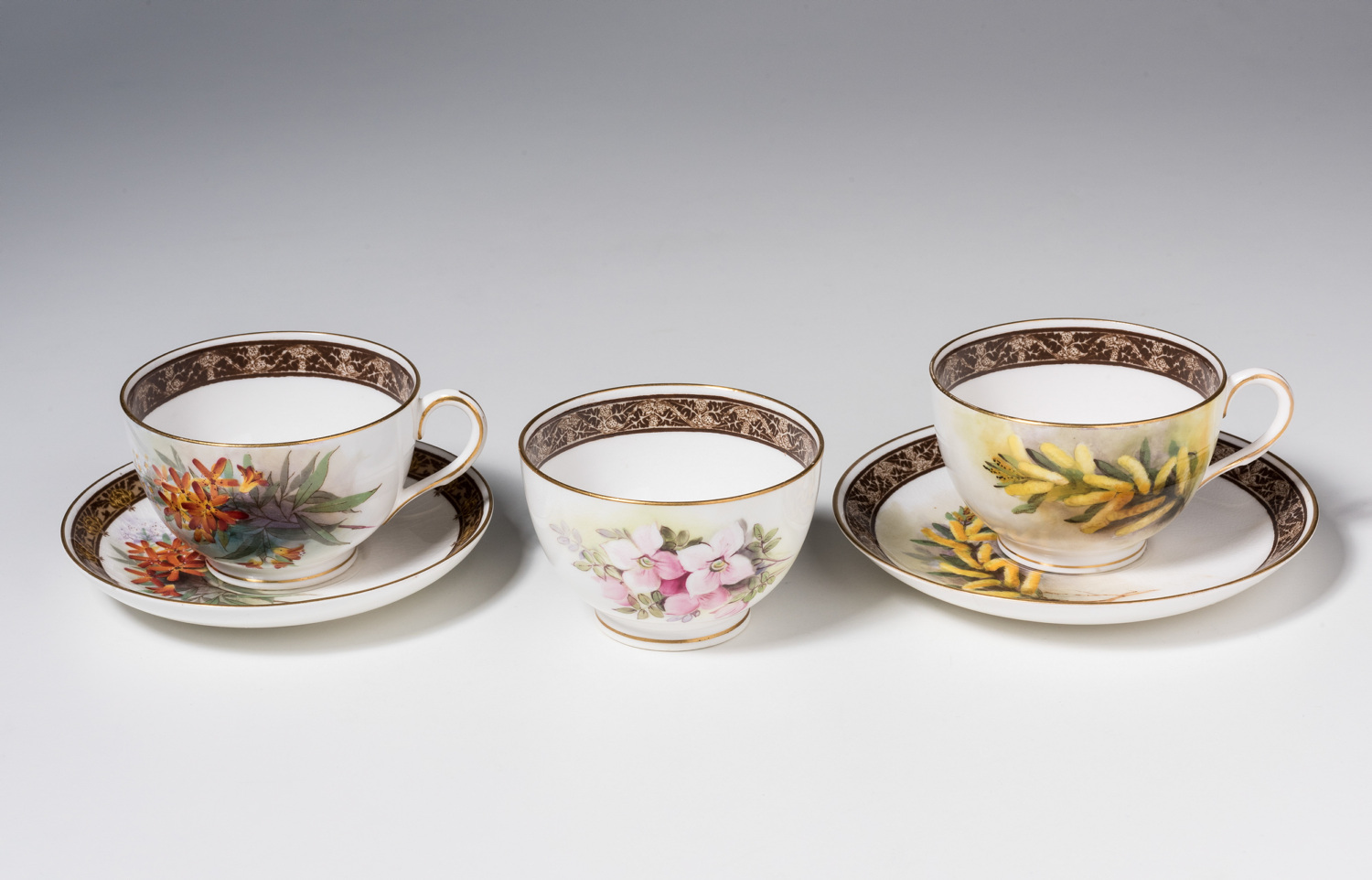
At the same time, the potteries also produced bespoke motifs for particular destinations. One such example is the work of Ellis Rowan, being transferred onto porcelain homewares. Marian Ellis Rowan was a renowned Australian botanical painter, disruptor of her male-dominated field of painting, she was awarded at Expositions and her work is housed in major institutions across Australia, including the National Library of Australia, National Gallery of Victoria, and Queensland Museum. Ellis Rowan’s work was commissioned by the Flavelle Brothers Ltd in Australia to fufill a demand for nationalist decorative homewares in the wake of federation (Douglas 2021). This relationship is further exemplifies the ability of the Staffordshire potteries to mass-produce a specific product for the colonial market of Australia.

At first glance the Staffordshire potteries seem to be an anomaly – with so many culturally significant ceramics being created within a small area. In reality, it was a combination of the right geography providing the materials, the strength and innovation of the local industry, the well-honed craft of the artists, and the international demand that made it a powerhouse in the 18th and 19th centuries. The history of pottery is still a major point of industry, art and tourism for Stoke-on-Trent today.
References
Douglas, Jon, and Yvonne Douglas. “Australian Motifs on Royal Worcester: Flavelle Brothers’ Association with Ellis Rowan.” 2021. Queensland History Journal, vol. 24, no. 11, Royal Historical Society of Queensland, 2021, pp. 1057–1065, https://search.informit.org/doi/10.3316/informit.163945846537220.
Barker, David (2004) “The industrialization of the Staffordshire potteries”, in D. Barker and D. Cranstone (Eds) The Archaeology of Industrialization. Maney Publishing: Leeds, UK.


You must be logged in to post a comment.