
For more than two decades, scientists and the public thought they knew what the soft coral Moolabalia nevillecolemani looked like.
Described in 2000 from specimens collected in the waters off Mooloolaba on Queensland’s Sunshine Coast, the species was classified using morphology alone. At the time, no genetic data was available to confirm where it belonged on the octocoral family tree. As a result, its true evolutionary relationships remained uncertain.
But the mystery ran deeper than its classification.

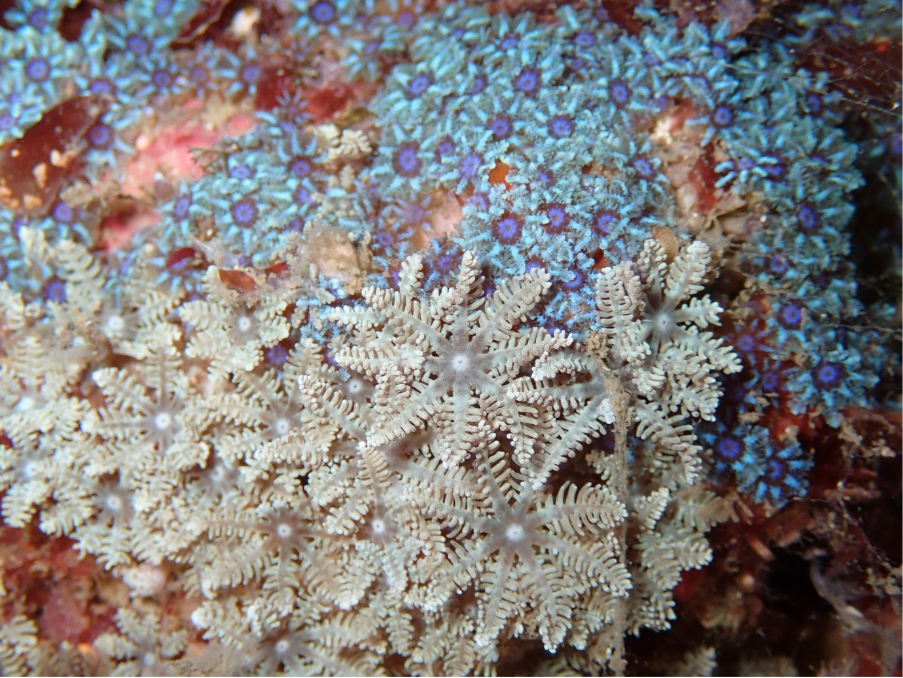
The original description did not include details about the colour of living colonies. Researchers instead relied on photographs taken by renowned underwater photographer Neville Coleman, whose extensive collection of slides is now held by Queensland Museum. Those images appeared to show a distinctive blue soft coral and, over time, the blue species became widely accepted as Moolabalia nevillecolemani.
There was one problem: the original photograph of the holotype specimen could not be found.
To solve the mystery, Queensland Museum researchers returned to the waters off Mooloolaba and collected fresh specimens from the species’ type locality. During their surveys, they discovered something unexpected. The familiar blue coral was growing alongside a similar-looking grey species.

Using a combination of DNA sequencing and detailed morphological analysis, the team compared both colour forms to the original type specimen. The results revealed that the grey coral – not the blue one – matched the species described in 2000.
Meanwhile, the blue coral turned out to be something entirely different. Genetic evidence suggests it belongs to a separate group of soft corals and may even represent an undescribed species.

The research also resolved a long-standing taxonomic question by confirming that Moolabalia belongs within the family Xeniidae, rather than remaining an unplaced or uncertain genus.
The study demonstrates the enduring value of museum collections. Historical specimens, field notes and photographs collected decades ago provided critical clues that, when combined with modern genetic techniques, helped researchers uncover the true identity of a coral living just off the Queensland coast.
Museum collections are made to be studied and this research shows that sometimes scientific findings don’t require uncovering something new. Sometimes they come from looking again at what we thought we already knew.
This research was recently published in Australian Journal of Taxonomy. Read the paper here: https://www.taxonomyaustralia.org.au/ajt/papers/bwsysv1ojv
This research was possible thanks to the team from the Sunshine Coast City Council and Sunreef as part of the Sunshine Coast Marine Bioblitz, who enabled collections of fresh samples from Mooloolaba.


You must be logged in to post a comment.