
Written by Tess Shingles
In the mid-20th century, non-First Nations artists capitalised on the popularity of Indigenous art. This saw a flooding of the Australian market with art that was superficially similar but featured colonialised characterisations of First Nations motifs and stylistic approaches.

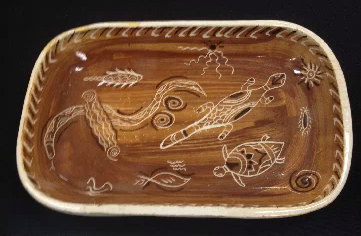
One such producer, Studio Anna (1953–1999), was established in Sydney by Czechoslovakian migrant Karel Jungvirt and his wife, Toni Coles. Their ceramics, featuring appropriated Aboriginal designs and motifs, were among their best-selling and most-collectable pieces, but they were made by artists with no Indigenous heritage whose cultural knowledge often came from books. Studio Anna distanced themselves from these derivative designs in the 1970s as the civil rights movement grew, and with it an understanding of cultural intellectual property.

Aboriginalia was also a part of this practice of misappropriation. Artists would decorate homeware with sentimental caricatures of Aboriginal people, like the noble savage or the piccinini, popular in Brownie Downing’s work. The Queensland Museum has a significant collection of objects featuring this style, many found in the Glenn Cooke collection. When we view these objects from a modern perspective, we recognise them as problematic. These commercially appealing stereotypes are often found decorating ashtrays and tourist-ware that perpetuate one-dimensional representations. This legacy of appropriation and stereotyping is critically examined in the work of Tony Albert, whose practice recontextualises Aboriginalia objects to expose the racism and cultural assumptions embedded within them.

The rise of these appropriated products coincided with past government welfare Acts and assimilation policies that pressured First Nations people to leave their culture behind, “observing the same customs and influenced by the same beliefs… as other Australians” (Hasluck, 1961). Yet during this period, Aboriginal ceramic art was also growing in visibility, led by artists such as Thanakupi, who used ceramics to tell traditional stories. Barambah Pottery was established in 1967, followed by the Yarrabah Pottery Club in 1973, both of which became key Queensland potteries over the next few decades. Although these initiatives were originally government-run, artists and communities transformed them into spaces for keeping culture, storytelling, and artistic practice alive through ceramics. Over time, ownership and control of these potteries were reclaimed by the artists and their communities.
Today we acknowledge that art by First Nations communities is imbued with cultural meaning and spiritual connection, and not to be copied without permission from knowledge holders. Artists like Tony Albert are using Aboriginalia as an act of reclamation, highlighting the inappropriate use of these caricatures through art like Mid Century Modern. It is important to hold these objects in cultural collections to show how cultural and colonial attitudes have changed and continue to evolve.
Discover more in Fragile and Forever: Ceramics from the Queensland Museum Collection, a free exhibition at Queensland Museum Kurilpa from 29 May 2026. Find out more: museum.qld.gov.au/kurilpa/whats-on/fragile-and-forever/
References:
Hasluck, Paul. MP “The Policy of Assimilation.” Native Welfare Conference, 1961, Australian Institute of Aboriginal and Torres Strait Studies. https://aiatsis.gov.au/sites/default/files/catalogue_resources/18801.pdf



You must be logged in to post a comment.