
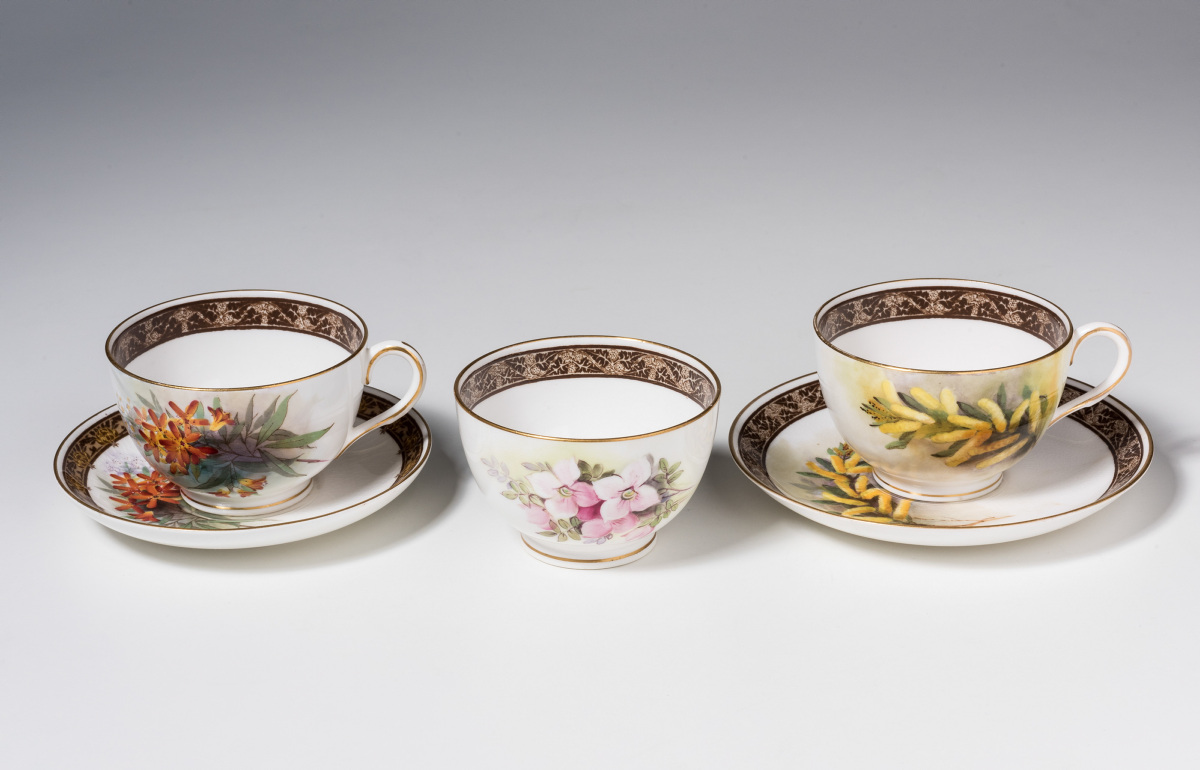
It seems there is a universal appeal to ceramics. You only have to look at the variety held in the Queensland Museum’s collection to see the diversity of forms and decoration, the many people that have collected different styles of ceramics, and even the many “things” that can be made from ceramic.
Why do people love ceramics?
Perhaps it is the immutability of ceramics – enduring despite their fragility – that inspires collectors. Maybe it’s the innate beauty of their decoration and form. Whatever the reason, ceramics are amongst the most popular of collectible items.
According to Mella Shaw (2016), the transformation that is inherent in fired clay is a ‘primal alchemy’ which communicates a ‘seductive … material quality’ of ceramics, making them a focus for collecting. They further suggest there are strong associations between ceramics and memorial and ritual1. Others see collecting as a behaviour with elements of curiosity, taste and a competition or challenge for quality as the driving forces2. It may also be that the memory encompassed in a ceramic object – be it a memento of an experience or place, an object of personal significance such as belonging to a much-loved family member, or as a representation of tradition – that influence a person’s decision to collect a particular piece, or a type of ceramic object.

Queensland Museum’s collection
Collecting is obviously a primary role of museums, often shaped or supported by the donation of private collections from specific enthusiasts. Queensland Museum, like many museums across the world, has a collection developed over time – with our ceramics collection accumulated over the course of a hundred years and influenced by several collectors. We hold ceramics that span thousands of years of human activity, that come from many different places across the globe, and that represent many cultures and historical social practices. Our collections hold over 3000 individual ceramic pieces and a further 5000-plus ceramic vessels and shards found archeologically. The collection spans not only Queensland history, but in fact world history – Egyptian storage vessels from Esna, household pottery from Ancient Greece and Rome, and medieval building remnants from Europe. Closer to home, we have archaeological assemblages from 19th and 20th century archaeological sites across Queensland, that represent ceramics from contact and convict-era sites, colonial agriculture, mining, and urban settings, and ceramics from diasporic communities such as the Chinese.
The social history collection includes some remarkable ceramics donated by individual collectors, and also our own targeted collections developed by museum curators. These include objects manufactured by early Queensland potteries, 19th century British imports of domestic crockery for the Australian market, the Allan Callaghan collection of Australian tourist-ware, and the Ben Ronald’s collections of well-known British ceramic producers, most particularly Royal Worcester. The First Nations collection includes ceramics from renowned First Nations artists, 1930s-1960s stylised decorative ceramics with Indigenous motifs, and we even hold cultural material made of clay from other World Cultures.

The secrets of ceramics
Ceramics can tell us many things about human lifeways in the past and contemporary social and cultural customs. Ceramics can also be researched in many ways – people have explored how ceramics project social identity – tracing elements of status signifiers, how decorations convey cultural knowledge, social ideologies and concepts of beauty, and even how societal change and innovation is reflected in changing morphologies and container types. We can also explore how the technology of production has changed and how that change has impacted the ceramics themselves. Ceramics can even be examined from the perspective of the transition from cottage industry and artisanship to industrialised production and the concomitant labour history.
Anthropological and archaeological research in particular has examined ceramic vessels through time as a means of understanding domestic life, the movement of people and ideas, cultural connections and global transport networks – both in antiquity and more recently with the changes of the industrial revolution.

Whatever your reason for collecting ceramics – be it the beautiful artistry of a piece, a way of demonstrating your social status through the quality of the crockery you use, or because of the stories they tell or the memories these objects hold for you, know you are not alone – and that we share a passion for ceramics.
Discover Queensland Museum’s ceramic collection in Fragile and Forever: Ceramics from the Queensland Museum Collection, a free exhibition at Queensland Museum Kurilpa in Brisbane: museum.qld.gov.au/kurilpa/whats-on/fragile-and-forever


You must be logged in to post a comment.