
Written by Dr Geraldine Mate
Queensland Museum is fortunate to hold several works by Thanakupi (also known as Dr Thancoupie Gloria Fletcher James AO). These ceramic artworks have been acquired over the last five decades via purchases from several exhibitions. This modest collection has allowed the museum to represent, in a small way, the works of this seminal artist.
Carrying Country into ceramic form
Widely regarded as a founder of Australia’s Indigenous ceramic art movement, Thanakupi was born in Napranum near Weipa on the north-west of Cape York. She was raised by her parents on the Presbyterian Napranum Mission, located on the traditional Country of the Thainakuith (or Thaynakwith) people. Her upbringing on Country, with Thainakuith Elders, provided a cultural base from where Thanakupi drew her inspiration.
Thanakupi began her career as a preschool teacher and in 1967 established the first kindergarten at her home in Napranum. In 1971 she travelled to Sydney, intending to enrol in a graphic arts course at East Sydney Technical College. Her application was declined due to her lack of secondary school qualifications, but, before leaving the campus she encountered the ceramics studio and subsequently, under Peter Rushforth’s tuition, began a tertiary arts education. This moment was to lead to a career spanning over 40 years, during which she used clay as a medium that combined cultural story1 with her artistry. 2 3
According to Simon Wright in a 2006 tribute to her work, “With pottery Thanakupi was able to develop a personal artistic language utilising a material that connected her with home, family, and Thaynakwith tradition. She was immediately attracted to working with clay because of the sacred purpose of the medium in traditional ceremonial life on Weipa: usually controlled by men, it was used to decorate sacred objects and create body paintings during ceremony.” 2
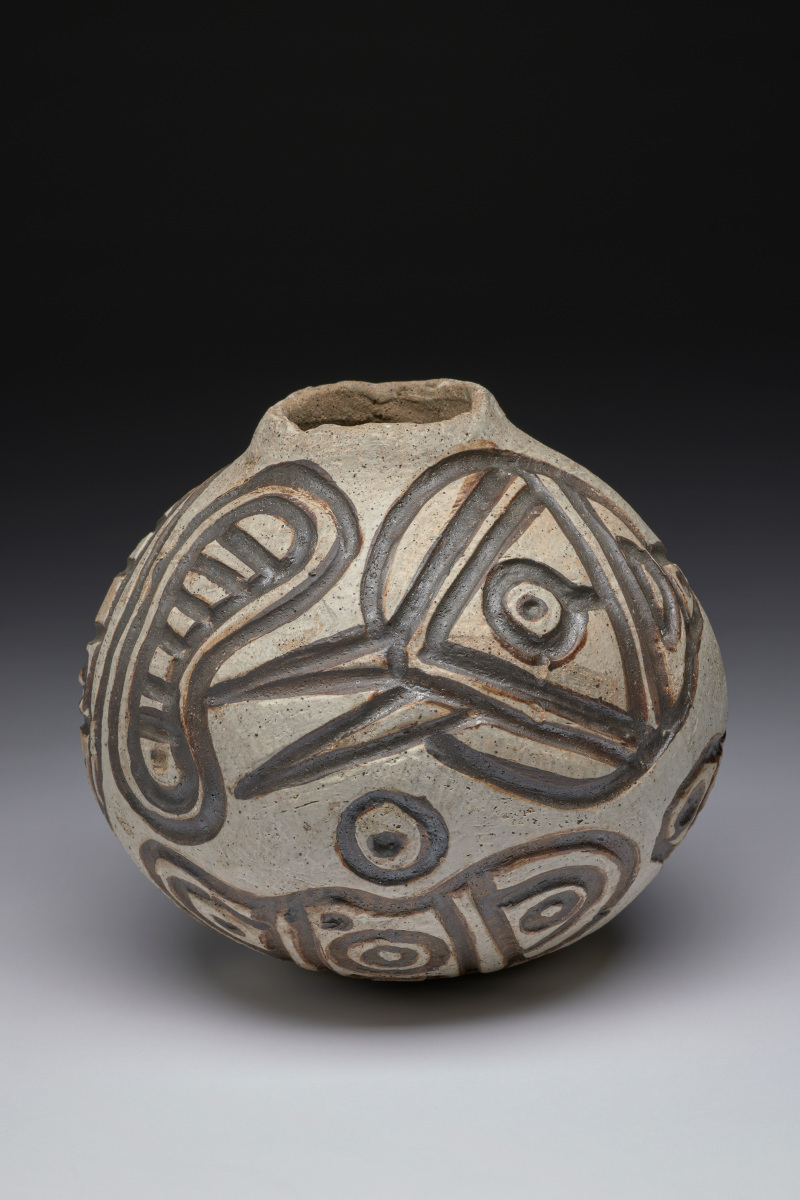
Building on traditional knowledge from her Country, Thanakupi presented cultural stories through ceramics decorated with incisions and painted motifs that emulate shapes from sand drawings.4 Translating her community’s stories into imagery on stoneware, she referred to these vessels as ‘story pots’.5 According to Natasha Brookes, these pots “both in their physical creation from earth, air, water and fire, and in their finished form as spherical story pots – embody the artist’s relationship with her land, her culture and the natural world.”
Works held by Queensland Museum
Among Queensland Museum’s collection is an example of these spherical pots, which have become icons of contemporary Australian art, and for which Thanakupi was internationally renowned. The spherical pot shown below, hand-built in stoneware with incised decoration, was acquired in 1988. Thanakupi’s spherical clay pots are regarded as symbolic of life, and the incised designs were influenced by traditional motifs and cultural practices such as sand drawing and ceremonial body painting.

Another example of Thanakupi’s work is a set of three vases (two with confirmed titles), which were the first of her works acquired by the Museum. These wheel-thrown pieces, decorated with brown slip depictions of trees, people and symbols draw on traditional stories of the Thainakuith. The vases also bear the distinct ‘Thancoupie’ signature.

Recognition and legacy
Thanakupi eventually returned to Queensland after establishing her practice in Sydney, setting up a studio at Trinity Beach near Cairns and continuing her art in a career well into her 70s. Throughout her career, she held a number of solo exhibitions and exhibited nationally and internationally. She is represented in state and national art institutions, and her career has been documented in several articles and books. Thanakupi herself has also published on the language and cultural traditions of the Thaynakwith. She was awarded Honorary Doctorates from Griffith University in 1997 and James Cook University in 2005. In June 2003, she was awarded an Officer of the Order of Australia (AO) for her contributions to the Indigenous Australian and artistic communities. In the latter part of her career, she was active in mentoring young Indigenous artists in North Queensland. Thanakupi passed away on her Country at the Weipa Hospital in April 2011.

Thanakupi was a dedicated custodian of significant cultural knowledge and drew deeply on this in the creation of her ceramic art. She conveyed numerous stories from Thainakuith culture through the figurative imagery featured in her practice. Many of Thanakupi’s ceramic, textile and metal artworks are held in institutions across the country, providing a lasting record of both her artistic output and the cultural narratives they embody. Thanakupi’s renown as a ceramic artist remains part of her enduring legacy and her contribution to the continuity of custom and ceremony in Thainakuith culture.
View the ceramic artistry of Thanakupi in Fragile and Forever: Ceramics from the Queensland Museum Collection, a free exhibition at Queensland Museum Kurilpa in Brisbane.


You must be logged in to post a comment.