
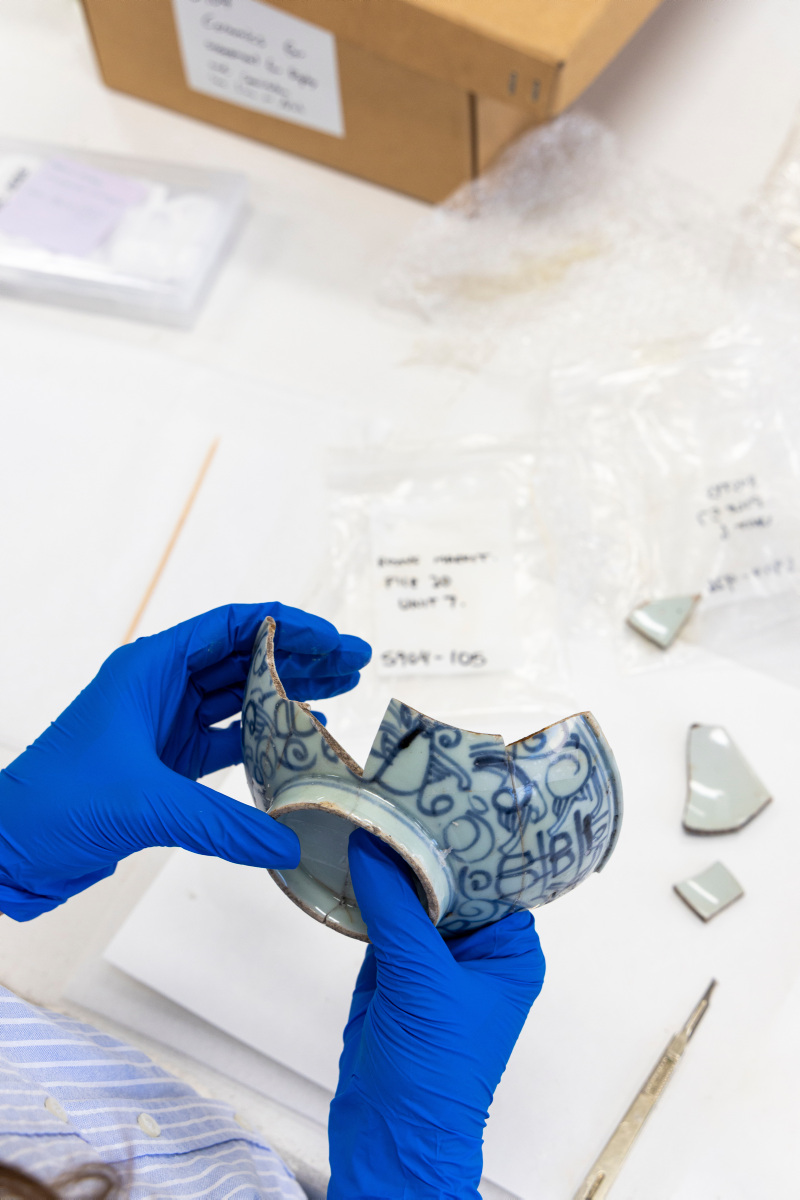
Everyone loves a good puzzle! And in archaeology, one of the puzzles regularly encountered is fragmented artefacts, particularly ceramics. Identifying separate, broken pieces that come from one vessel and joining them together is called conjoining, and is one of the post-excavation activities that archaeologists and conservators undertake. If you’re lucky, it’s an easy puzzle, with large pieces all found together. Other times, it can take months to identify different fragments that match, and there may be many small fragments to piece together.

Why do we conjoin artefacts?
There are many reasons why we might choose to conjoin artefacts. It gives archaeologists an opportunity to understand how an artefact may have fractured – the event that caused it, whether intentional or accidental – and points to human behaviours in the past. Conjoining also tells us about the design of a vessel – its shape might tell us what it was used for or how it was designed to perform a particular function.
Identifying two or more parts from one original vessel may help us understand how an archaeological site was formed – for example, whether artefacts stayed in place or were scattered far and wide after they were deposited.
For museum archaeologists, putting partial or whole vessels back together gives visitors a sense of what objects might have looked like. But it also sheds light on what archaeologists “see” when they pick up an isolated artefact – how they can imagine the form of an original ceramic pot or plate from an individual fragment.
How it’s done
Using processes we all know from jigsaw puzzles, conservators and archaeologists look for patterns and shapes that match up. They find edges and lines that fit together, being careful not to damage the edges of the pieces. Conservation principles are applied – so that any repairs are made in ways that are identifiable and reversible.
We have recently been conjoining artefacts for Fragile and Forever, Ceramics from the Queensland Museum Collection, an exhibition on at Queensland Museum Kurilpa in Brusbane from 29 May 2026. The conservators have carefully pieced together porcelain serving dishes and a 19th century toilet bowl!


Queensland Museum Conservator, Margot Murray piecing together a porcelain bowl from Rusty’s Market, Cairns. Photographer Lee Wilkes, Queensland Museum (dl8346, dl8331)


What we have learned from these archaeological puzzles
These artefacts tell us quite a lot about the past. We can glean details about the cultural and social standards that were practiced, tied to a specific place and time through the archaeological excavation. Putting fragmented objects back together shows the shape of domestic facilities like water closets, and points to the people who manufactured these furnishings. And examining the design elements, shape, and places of manufacture of porcelain point us to the global distribution networks of the past.
Overall though, conjoining is like detective work, the moment that fragments are married up giving a thrill of achievement – just like a good jigsaw.
Fragile and Forever: Ceramics from the Queensland Museum Collection is free and open daily, learn more: museum.qld.gov.au/kurilpa/fragile-and-forever


You must be logged in to post a comment.