
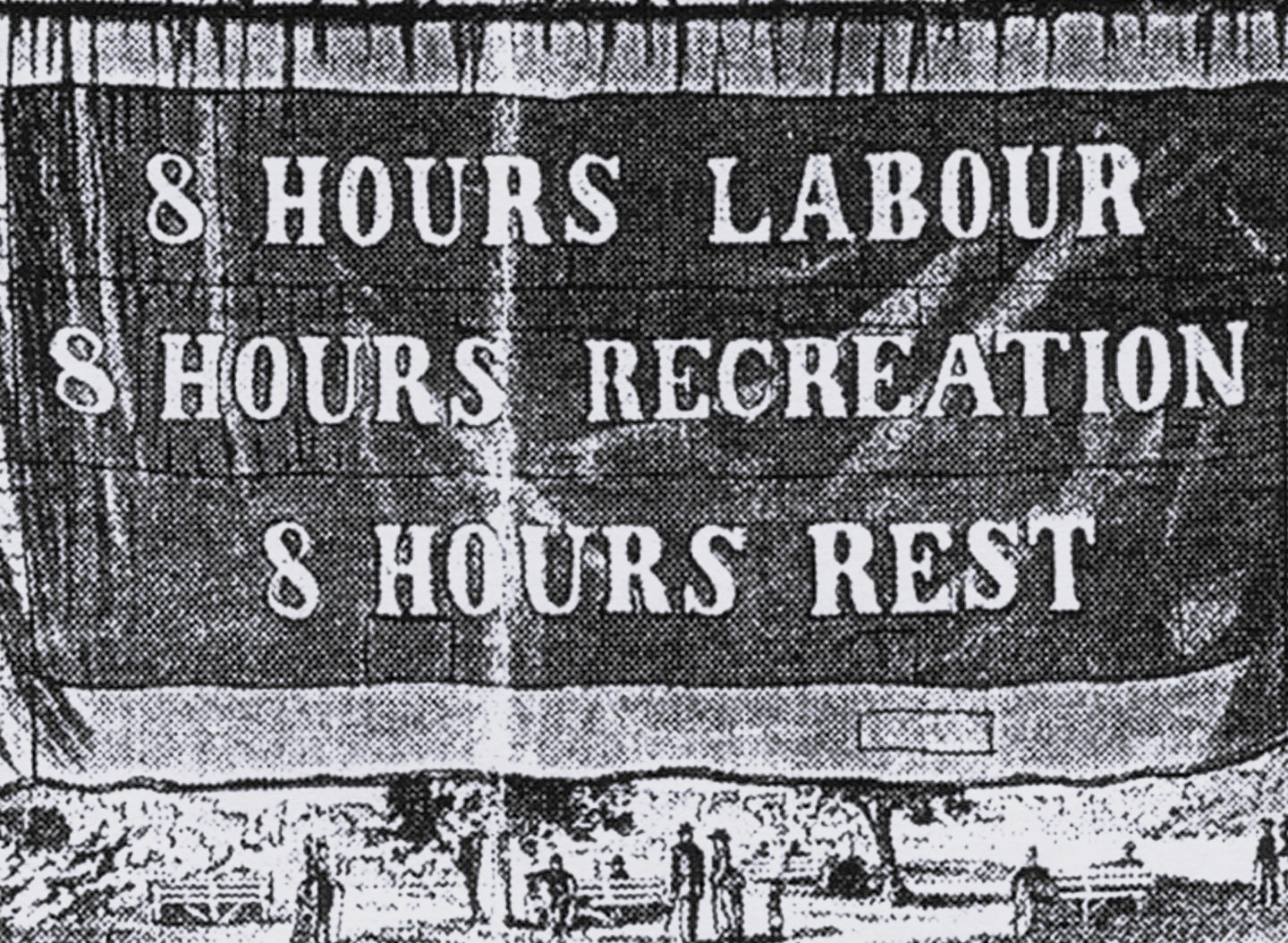
For more than a decade, the call for ‘work-life balance’ has echoed through workplaces, and more recently, the idea of ‘psychosocial health’ has found its place in legislation.
In 2026, we mark 170 years since stonemasons downed tools at the University of Melbourne and marched in protest, calling for an eight-hour workday. Their contribution to fairer working conditions is well recognised today. Many of these workers had come from England and Europe, where protest and collective action were already part of everyday life—bringing with them a spirit of change that helped shape workplaces here.1
Yet, long before psychiatrists, psychologists and social workers began to advance models of this concept, stonemasons had held concerns over the tension between time spent at work and non-work time, and a resistance to work dominating their lives.2 As well as providing the material means for survival, stonemasons considered it necessary for work to bestow ‘dignity, independence and leisure’.3 In 5th century Athens, Socrates, son of a stonemason, introduced the idea of ‘self-improvement’ as a political act, insisting that caring for one’s self, specifically, ‘care for the soul’, was vital to better serving the world.4

In Queensland the Operative Stonemasons Union, formed in January 1858, followed suit, with Brisbane stonemasons John Petrie and Joshua Jeays, negotiating the construction of a new gaol in what today is Petrie Terrace, to include eight-hour working conditions for themselves and their employees.5 The first Queensland Eight-Hour Day procession took place on 1 March 1865. Eight Hour Day celebrations were formally changed to the first Monday in May in 1901, when it was gazetted as a public holiday by the Queensland government. In 1912 the day was renamed Labour Day.

The small booklet pictured above sets out as the Operative Stonemasons’ first organisational principle that eight-hours be recognised as ‘the standard day’s work’. The booklet is part of a rare collection of documents, stonemasonry tools and carved sculptures related to Queensland naturalist, collector and one of Brisbane’s leading nineteenth-century stonemasons, John Howard (J H) Simmonds (1862 – 1955). The stonemasonry tools are believed to have been brought from England and handed down through at least four generations of stonemasons in the Simmonds family.


A third-generation stonemason, John Howard Simmonds was born in Carlton, Victoria, where his British-born grandfather, builder and stonemason, John Simmonds (Snr), had migrated from Blandford, Dorsetshire in November 1852 with his wife Ann and their eight children. In 1856, after working for several years for various stonemasonry businesses, John Simmonds Snr established his own firm, ‘J Simmonds’.
Following John Simmonds Snr’s death in 1860, his son, John Simmonds Jnr (1828-1889), took over the family stonemason business, eventually apprenticing his son, John Howard (JH) Simmonds, at the age of eighteen.6 In 1880, the family moved to Brisbane where John Simmonds Jnr established a stone works in Adelaide Street.

Following his father’s death in 1889, J H Simmonds, then twenty-seven, took over and continued to operate the business. In March 1896, the business relocated to Ann Street adjacent to St Andrew’s Church and ceased operating in 1920 with the retirement of John Howard at the age of fifty-eight.
A talented artisan from early age, J H Simmonds had been awarded a silver medal at the Intercolonial Juvenile Industrial Exhibition for his ‘Carving in Marble’, a finely sculpted flower basket, now part of Queensland Museum’s collections.

Several examples of J H Simmonds monumental works are today included in the Queensland Heritage Register.7 Among these is a three-tiered alabaster fountain in Renaissance-revival style with motifs incorporating leaves and shells. Completed in July 1880, the fountain was situated directly in front of Parliament House in Brisbane’s Botanical Gardens and surrounded by a circle of palms. The fountain was removed during a redevelopment of the gardens in 1958 and its whereabouts today are unknown.

A History in Stone
As one of the earliest artistic and cultural forms of labour and, as a craft, stonemasonry is associated with many of the world’s most distinguished buildings and monuments – for example, the Pyramids, Stonehenge, the Coliseum, the Taj Mahal. In medieval Britain and Europe, castle building was an entire industry for stonemasons.
Closer to home, many of Brisbane’s most distinguished buildings, such as City Hall and Parliament House, are testament to the skill of the early monumental masons of Brisbane, including those of the city’s first Mayor, politician, architect, stonemason and building contractor, John Petrie.8 Stonemasonry is also strongly associated with the geological history and quarries and Brisbane and remains closely tied to the city’s early civic architecture.

The quality of the many of the monuments in Brisbane’s cemeteries demonstrates the skill of the craftsmen who created them, with many referring to themselves as ‘sculptors’ rather than stonemasons. Churchyard and cemetery memorials are receiving increasing focus as places that embody social history and themes of family, demography, art styles and where the life of communities and those who lived there are recorded.9


Statuettes depicting a small angel and young girl reading, made by J H Simmonds. Simmonds collection. Queensland Museum, Peter Waddington.
As was evident in the Simmonds family, the complex designs and skills associated with stonemasonry were usually handed down through families, with sons apprenticed to fathers. Traditionally, an apprenticeship lasted up to seven years until they had mastered their craft and become journeymen – allowed to travel or take ‘journey’. As well as the craft of stonemasonry, apprentices were required to learn drawing, geometry, and, surprisingly, to dance, ‘to further their understanding of spatial awareness.’10
Although the ranking no longer formally exists, a master stonemason, whose training also included advanced mathematics and architecture, was highly skilled and free to travel anywhere in the world to complete their work. Masters were able to recognise each other through a secret password – the ‘Master’s word’ – and secret grip, or handshake. Many members of stonemasons’ guilds used ‘secret languages’, known as ‘argots’, ‘cants’, or the ‘bine’.11 There were also ‘secret signs, methods of handling their trowels, squares, and other tools, ways of pointing, and laying and smoothing mortar’.12 Today there are only twelve Guild Masters in the world, each with a PhD/ThD in Fine Arts. As well as academic qualifications, Guild Masters are required to have a minimum of thirty years continuous work as a stonemason.13
Crafting the tradition
Today, the skills of stonemasons are increasingly being sought for training as conservators and as restorers of heritage buildings and monuments throughout Australia. However, despite the deep history of their craft and significant contribution to, and influence on, Australia’s built environment, stonemasonry and works by stonemasons are extremely rare in Australian and international museum collections.
Following the philosophical underpinnings of stonemasonry, John Howard Simmonds pursued an intellectual life outside his work, focussing his attention on the flora and fauna of his new surroundings and contributing his time and skills to collecting, documenting, and sharing his knowledge with others, a passion he shared with his wife, Rose Simmonds (née Culpin) (1877–1960) and son, renowned Queensland plant pathologist John (Jack) Simmonds (1901–1992).
As social objects which illustrate numerous interpretive ideas relevant to culture, society, economics and politics, the Simmonds collection tangibly connects us to the history and craft of stonemasonry and to the crusade for fairer working conditions – and to that eternal quest for work/life balance.
- Prothero, I 1997, Radical artisans in England and France, 1830-1870, Cambridge University Press, Cambridge. ↩︎
- Ibid. ↩︎
- Ibid. ↩︎
- Horowitz, A, ‘Socrates as philosopher’, York University, 2010-2011.
URL: https://www.yorku.ca/horowitz/courses/lectures/03_socrates_philosopher.html ↩︎ - Cross, M 2008, ‘The eight-hour day in Queensland’, Queensland Journal of Labor History, 6, pp. 37-40. ↩︎
- Ibid. ↩︎
- Queensland Heritage Register. URL: https://www.qld.gov.au/environment/land/heritage/register ↩︎
- Laverty, J 1974, John Petrie (1822–1892), Australian Dictionary of Biography.
URL: https://adb.anu.edu.au/biography/petrie-john-4394 ↩︎ - Jones, R & Snell, K D 2021, ‘Angels in English and Welsh churchyard and cemetery memorials, 1660–2020’, Family and Community History, 24:2, pp. 85-119. URL: https://doi.org/10.1080/14631180.2021.1943199 ↩︎
- ‘A lost craft? Rediscovering the art of stonemasonry’, Norman Rae Gallery blog: URL: https://normanreagallery.wixsite.com/blog/post/a-lost-craft-rediscovering-the-art-of-stonemasonry ↩︎
- Lee, P, ‘The secret language of the stonemason’, Square Magazine
URL: https://www.thesquaremagazine.com/mag/article/202204the-secret-language-of-the-stone-masons/ ↩︎ - Ibid. ↩︎
- ‘A lost craft? Rediscovering the art of stonemasonry’, Norman Rae Gallery blog: URL: https://normanreagallery.wixsite.com/blog/post/a-lost-craft-rediscovering-the-art-of-stonemasonry ↩︎

You must be logged in to post a comment.