
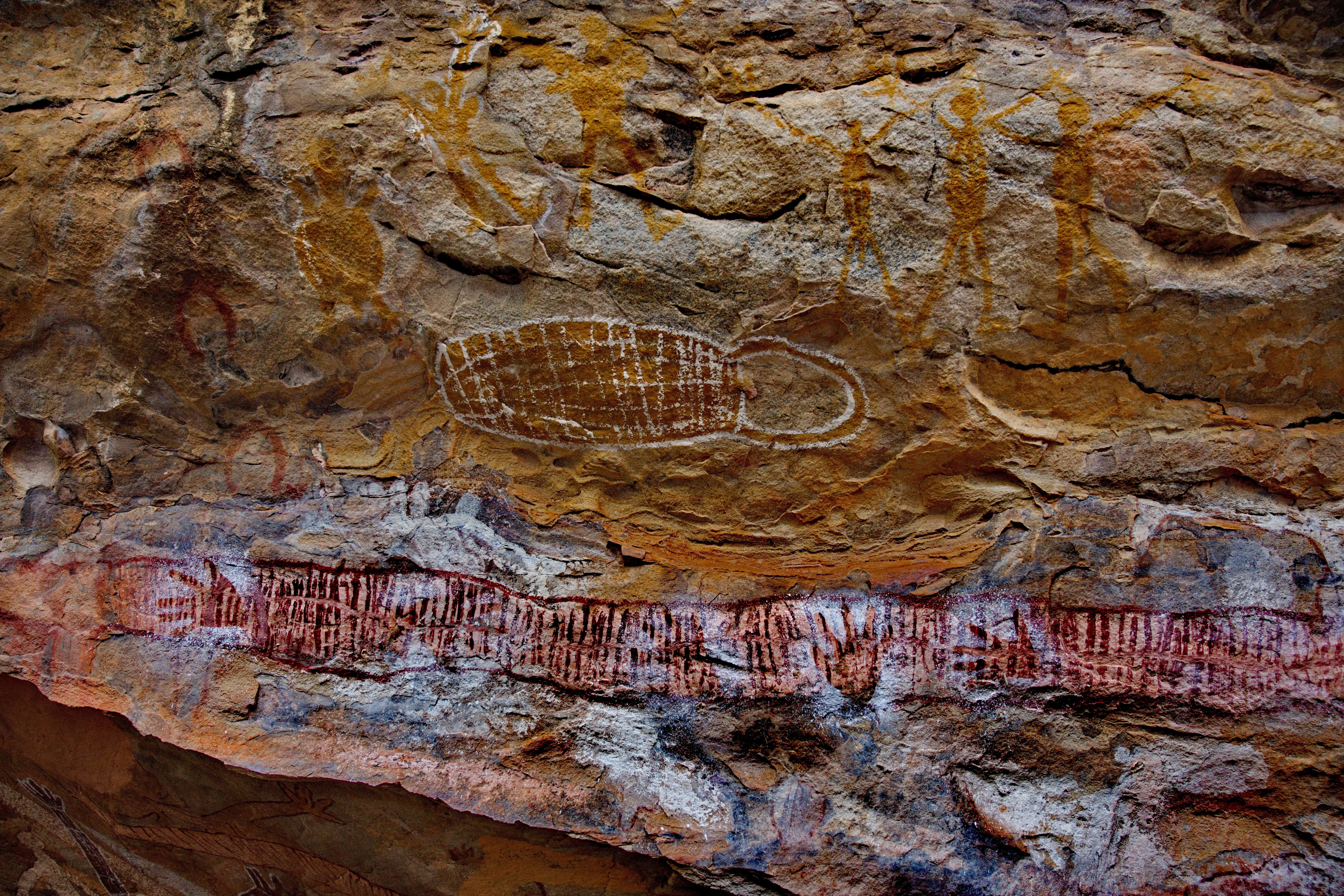
High in the sandstone country of Cape York Peninsula, ancient stories are written across the escarpments.
Around the small Queensland town of Laura lies Quinkan Country, one of Australia’s most significant rock art regions. Its sandstone galleries contain a remarkable diversity of Aboriginal paintings and engravings, including depictions of people, animals, objects, tracks and distinctive spirit figures known as Quinkans. The region is home to an estimated 10,000 rock art sites.1 2
A window into ancient Queensland
The rock art of Laura is far more than a collection of beautiful images.
Quinkan Country is a dynamic cultural landscape where traditions, knowledge, stories and connections to Country continue today. Traditional Owners and cultural custodians maintain an enduring association with the landscape, with cultural knowledge embedded in the rock art and archaeological sites.
The area is particularly renowned for its depictions of Quinkan spirit beings. These include the tall, slender Timaras and the larger, rounded Imjims, also known as Anurra. These distinctive figures are one of the defining features of the Laura rock art region.
Alongside them are paintings of people and animals including macropods, dingos, echidnas, fish, birds and reptiles, as well as tracks, plants and objects. The region also contains older geometric engravings. 3
Together, these images form part of a rich cultural landscape that provides insights into the people, their artistic traditions and connections to Country over many thousands of years.
Evidence of people living in Quinkan Country dates to more than 40,000 years ago, while rock art in the region has been dated to around 34,000 years ago.

Who are the Quinkans?
One of the most recognisable features of Laura’s rock art is the mysterious and striking figures known as Quinkans.
The Laura region takes its name from these representations. Quinkan figures are associated with spirits or supernatural beings believed to inhabit the sandstone country.
Their distinctive forms have become synonymous with Quinkan Country, but their significance extends beyond their visual appearance. The figures are part of a broader cultural landscape of stories, knowledge, traditions and connections to Country.
For visitors, they can be captivating to look at – but they are best understood within the cultural context in which they were created and continue to hold meaning.


A landscape full of layers
One of the extraordinary things about Laura Rock Art is that it wasn’t created at one moment in time.
Rock shelters and galleries contain layers of paintings and engravings produced over different periods. Community leaders working alongside researchers have combined oral histories and studies of the rock art with archaeological investigations and dating of materials from nearby occupation sites to better understand the region’s long history. [3]
Some paintings appear over older, weathered engravings, creating layers within the rock shelters themselves. The imagery also varies considerably, including figurative paintings, animal forms, geometric designs and other motifs.
The result is a remarkable visual record of human activity and cultural expression.
And there is still much to learn.
Research, surveying and cultural site management continue today, with Traditional Owners, cultural custodians, researchers and the Laura Rangers contributing to the understanding and protection of Quinkan Country. 4
Caring for Country
The significance of Laura’s rock art extends beyond the individual images. The galleries are part of a broader cultural landscape that requires ongoing care and protection.
Laura Rangers undertake cultural site recording and management across Quinkan Country. Their work includes protecting rock art from wildfire, managing vegetation and feral animals, maintaining exclusion fencing and involving young people in caring-for-Country activities.
This work is particularly important because the rock art exists within a living landscape – one that continues to be cared for and connected to by Traditional Owners and communities.
In 2018, Quinkan Country was added to the Australian National Heritage List in recognition of its outstanding heritage value. The listing recognises the place as a significant cultural landscape and acknowledges the knowledge it can contribute to understanding Australia’s Aboriginal history, rock art and human occupation.

From remote galleries to the Museum
Many of the rock art galleries around Laura are located in remote parts of Cape York. While some sites are accessible to visitors, others require guided access, and the protection of the rock art remains an important priority. 5
‘Quinkan Country’, an exhibit in the Stories of Country Gallery at Queensland Museum Kurilpa in Brisbane, features a stunning installation of Laura Rock Art, offering visitors another way to encounter this extraordinary cultural heritage.
Rather than simply looking at the images as objects from the distant past, take time to consider the landscape they come from – the sandstone shelters, Country, stories and generations of knowledge connected to them.
Visitors can look closely at the figures and animals. Notice the different styles, colours and layers. Think about the people who created these images, the people who have continued to care for Country and their generosity in sharing their culture, and the knowledge that remains connected to these places today.
A living connection to Country
In 2024, the Cultural Landscapes of Cape York Peninsula, which includes Quinkan Country, was added to Australia’s UNESCO World Heritage Tentative List. The listing recognises the exceptional cultural and natural values of the region and the enduring role of Traditional Owners in caring for Country. 6
For the Traditional Owners and cultural custodians of Quinkan Country, these landscapes are not simply archaeological sites or windows into the past.
They are places of continuing cultural connection.
And that’s what makes Laura Rock Art so extraordinary. It isn’t just evidence of an ancient past – it is part of a living cultural landscape that continues to connect people, Country, knowledge and story.
Visit ‘Quinkan Country’ in the Stories of Country Gallery now on at Queensland Museum Kurilpa in Brisbane: museum.qld.gov.au/stories-of-country
References:
- Department of Climate Change, Energy, the Environment and Water (DCCEEW), “Quinkan Country.”
Australian Government, National Heritage List. Updated 17 August 2026.
Read the Quinkan Country National Heritage listing ↩︎ - Queensland Government, “Laura.”
Queensland Government, First Nations cultural awareness, heritage and arts.
Read the Queensland Government history of Laura ↩︎ - Department of Climate Change, Energy, the Environment and Water, Rock Art Thematic Study.
Australian Government, 2016. The study discusses the Laura rock art region, its figurative paintings, animal motifs, engravings and Quinkan figures.
Read the Rock Art Thematic Study ↩︎ - Queensland Government, “Laura Rangers.”
Information about the work of Laura Rangers in caring for Quinkan Country and its rock art sites.
Read about the Laura Rangers ↩︎ - Queensland Government, “First Nations tourism experiences – Laura Rangers.”
Information about visiting Quinkan Rock Art Galleries and the role of the Quinkan Cultural Centre.
Read about visiting the Quinkan Rock Art Galleries ↩︎ - Department of Climate Change, Energy, the Environment and Water, “Cultural Landscapes of Cape York Peninsula added to Australia’s UNESCO World Heritage Tentative List.” 20 June 2024.
Read about the Cape York Peninsula World Heritage Tentative List nomination ↩︎


Leave a Reply