
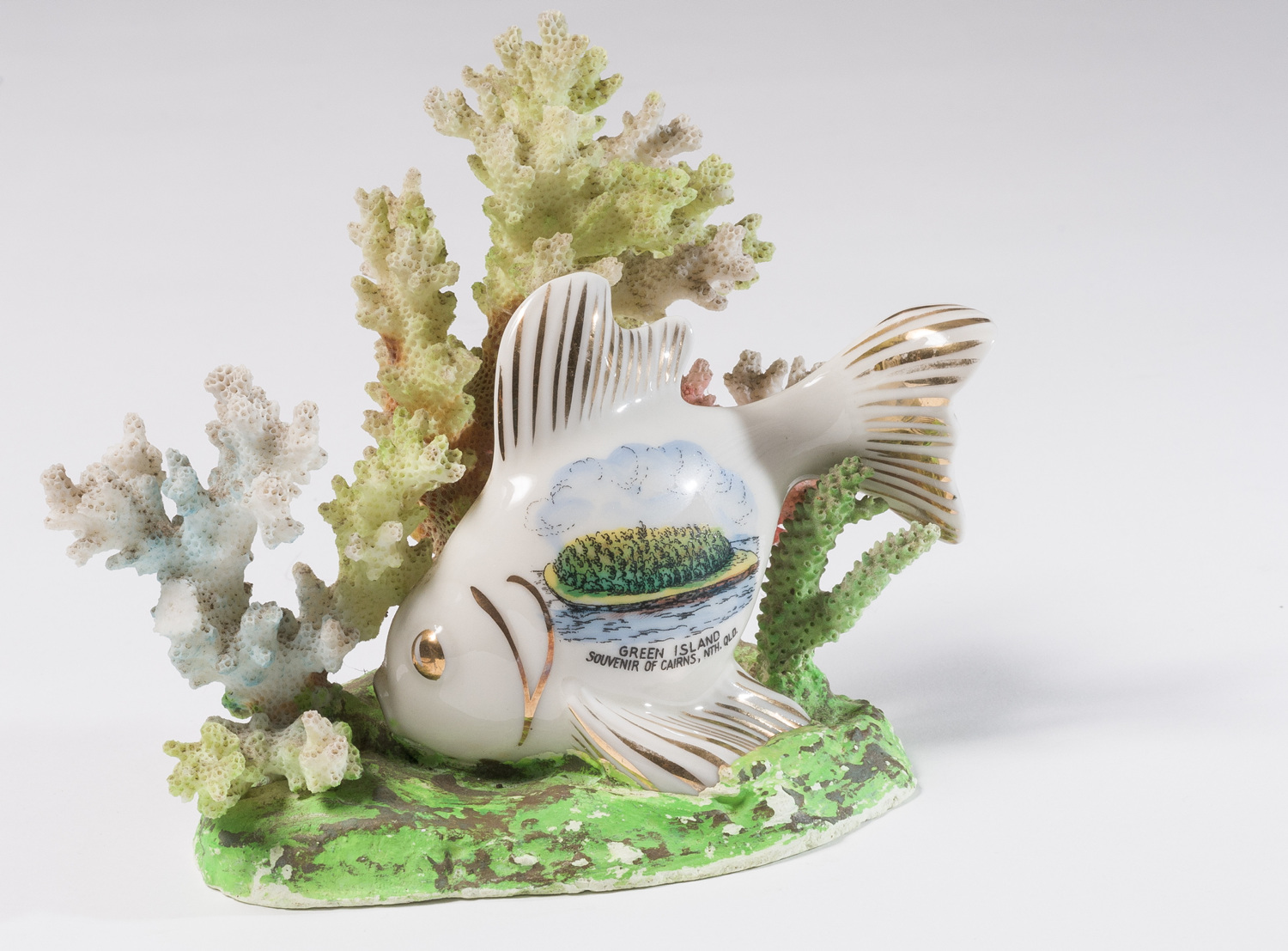
Tourist-ware holds a special place in popular culture, an attempt to capture an experience or memory with a physical object. In mid-century Queensland, there were two main drivers of the tourist ware boom: an uptake in travel, and mass production of ceramic tourist-ware.

Throughout the 20th century, but particularly post-World War Two, people had the money and leisure time to travel and could more readily afford cars. Australians were the target of extensive marketing campaigns encouraging them to visit the Sunshine State.
“the State is fortunate in possessing the ideal combination for tourist development-a climate which appeals greatly to holiday-makers and the finest array of natural attractions in Australia: the Great Barrier Reef and islands, hundreds of miles of beaches, mountain scenic spots, national parks, the tropical north, the Darling Downs, and the inland.”
Road trips were within financial reach of the average Australian, with the Australian Bureau of statistics declaring “the motorist plays a vital role in the domestic tourist market” (Mumme, 1970) The 1960s saw transport advances such as the completion of a bitumen road crossing the state from north–south and Queensland Rail saw out the steam engine, in favour of longer-range diesel engines, and the implementation of more comfortable stainless steel carriages. There was a concerted effort by the Queensland Government to lure tourist dollars to our sunny beaches with the Gold Coast getting their first high rise (1959), meter maids (1965), the Seaquarium (1965), and Queensland’s largest shopping centre – the Sundale Shopping Centre at Southport (1968). Other major centres like Toowoomba, Cairns and Mount Isa saw a large tourist growth during this decade, tapping into a growing market of travellers.


Olive Ashworth Publicity Services tourist brochures; Proserpine c. 1960s (H3850), Magnetic Island, c. 1960 (H41784), McLean’s Roylen Cruises, c. 1970 (H3849,. Queensland Museum collection.
Tourists were more likely to spend money while on holidays, and by creating a souvenir that highlighted a local landmark or event, it gave tourists a piece of collectible memorabilia to purchase. This not only created local revenue but also promoted the destination when the ceramic was shown off back home. The idea of a keepsake or a visit to the gift shop became a holiday ritual of commerce and memory.

Mass production also ensured the success of ceramic tourist-ware. With a newly enthused market, meeting demand became essential. Traditional tourist-ware included handmade crafts and local designs, something you couldn’t find anywhere else. But in the 20th century’s age of mass production, more generic designs emerged. Similar ceramics were produced, often in white with a different scene or name painted on the face to set it apart from the tchotchke you would find in the next town. The market was not as concerned with representing the local culture but did lend itself to collecting, reinforcing the idea that tourists were travelling more frequently, further, and to multiple destinations and they were able to collect ceramics wherever they went.

Queensland Museum holds many examples of tourist-ware, The tourist-ware industry still continues, travel is cheaper and easier than ever before, and mass-production continues to supply the market. It seems we just can’t resist taking a little piece of novelty ceramic home with us as a physical manifestation of a particular time and place.

To explore more tourist ware ceramics, visit Queensland Museum Kurilpa’s Fragile & Forever: Ceramics from the Queensland Museum Collection exhibition, free and open daily from 29 May 2026: museum.qld.gov.au/kurilpa/fragile-and-forever
References
Mumme, A. W. QUEENSLAND YEAR BOOK 1969, No. 30, Commonwealth Bureau of Census and Statistics Queensland Office.1970, Pages: 32-35. Web 6 May 2026. http://www.ausstats.abs.gov.au/ausstats/free.nsf/0/7438C65BA298C724CA257AFE001471B1/$File/13013%20-Qld%20YrBook%20-%201969.pdf

You must be logged in to post a comment.