
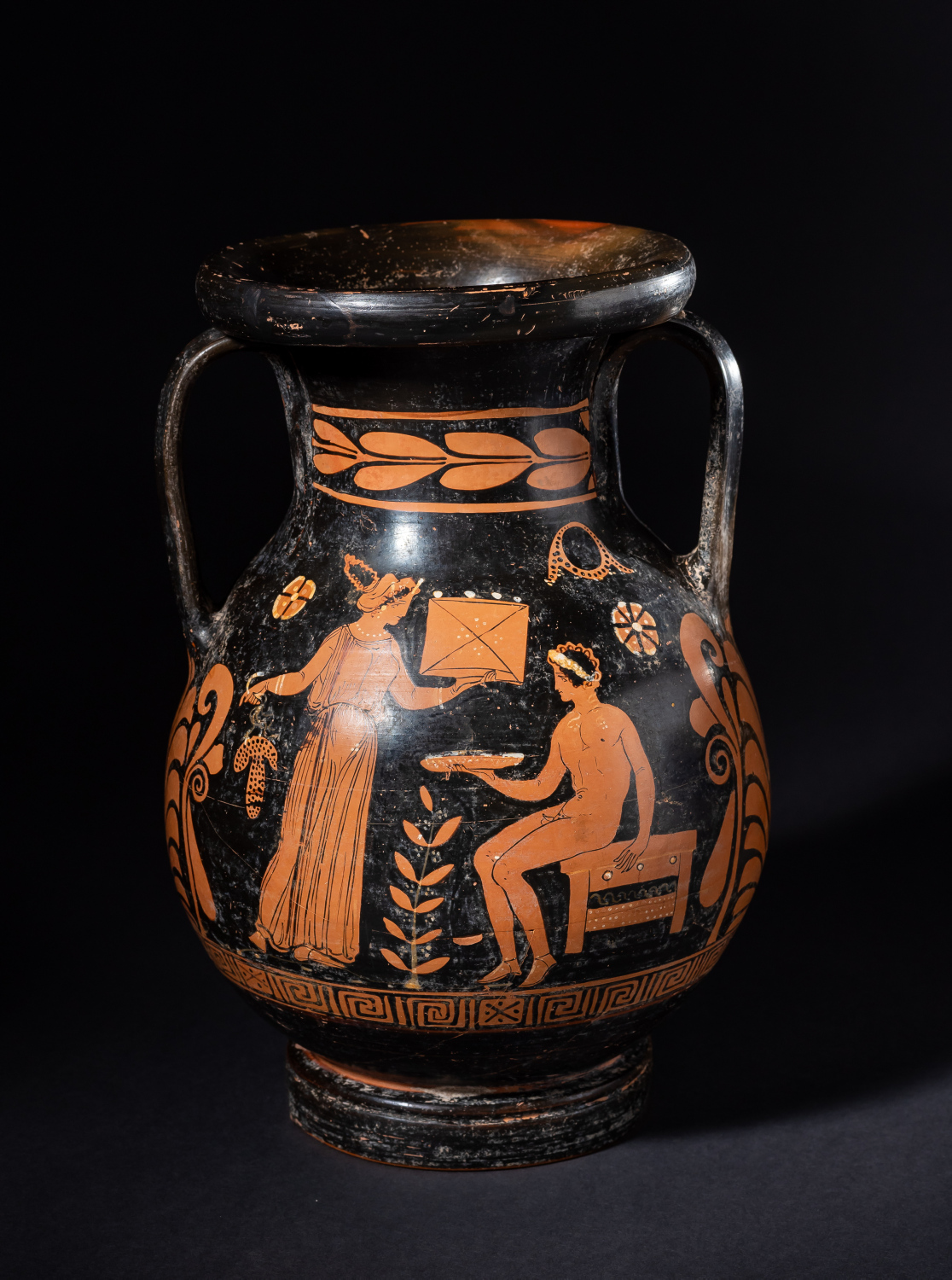
What a curious exercise to mentally reach back in time and intimately connect with a person, an artist whose artistic vision, design and technical skills which we can fully appreciate today as much as the artist’s community and customers did some 2000 years ago. Through archaeology, we are able to time travel, to experience past lives to a limited degree. We can connect to people’s thoughts, emotions, ideas and abilities through the things they produced.
The Queensland Museum Classics collection holds ceramic vessels created by two renowned ancient potteries: the Varrese Painter and the Little Masters workshop. Whilst the specific names of the ceramicists who created these incredible vessels is not known to us today, their specific aesthetic decoration and vessel shape and designs are still recognisable to an individual, place and time.


The Varrese Painter was a leading figure in the large-scale production of Apulian red-figure pottery during the 4th century BCE. Based in Southern Italy, this potter’s work exemplifies the shift from the understated designs of the mainland Greek vessels to the bolder tastes of the Western Mediterranean colonies. Here in the Museum, we hold one such vessel created in c. 330 BCE – an Apulian red figure Pelike. A pelike is an ancient Greek ceramic vessel typified by its design: a sagging body, narrow neck, and two vertical, flanged handles. Due to their size and design, pelikes were often used for storing wine, oil, or as burial containers for ashes. The Varrese Painter’s style is exemplified by the depiction of mythological scenes on the vessels, the inclusion of white and yellow paint to create a sense of depth and luxury and framing the scenes with borders above and below the imagery.
The Museum collection also contains a vessel produced by the Little Masters workshop, which flourished in Athens, Greece, between 550-525 BCE. This workshop of potters and painters became renowned for the production of delicate, thin-walled cups known as “lip cups” and “band cups” – refined and elegant forms of kylix (drinking cups). The name “Little Masters”, however, alludes to the fact that they produced many of their vessels in miniature. In addition, the artists often included an inscription that may name the potter or the painter or offer a greeting to the user, for example, “Hail and drink well”. And while we often focus on the painted scenes and decorations, it’s important to remind ourselves that this workshop was renowned for producing exceptionally fine vessels (often as thin as a few millimeters) that required a high level of control over the clay and the kiln.
Despite the centuries and distance between them, both the Varrese Painter and the Little Masters works provide us with an intimate connection over time to the thoughts, emotions, religious beliefs and the design and technical know-how of these ancient schools of pottery. They remind us that whether working on the scale of a giant funerary urn or a tiny wine cup, the ancient artisans spoke to their community with a technical brilliance that remains startlingly clear today.
Explore ceramics from ancient cultures in Fragile and Forever: Ceramics from the Queensland Museum Collection, a free exhibition at Queensland Museum Kurilpa: museum.qld.gov.au/kurilpa/whats-on/fragile-and-forever


You must be logged in to post a comment.