
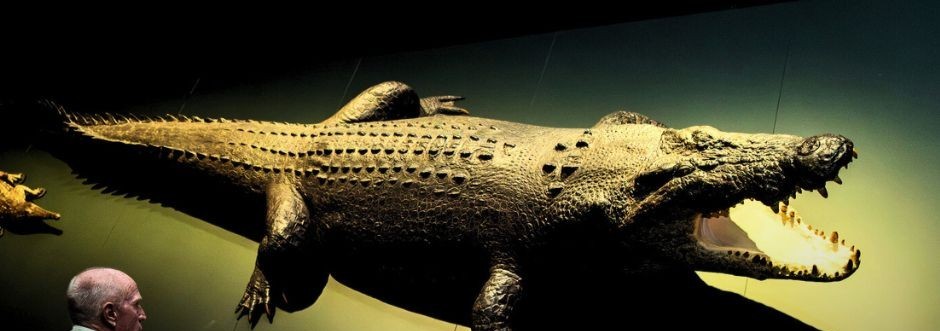
In the rivers and floodplains of the Northern Territory, few animals have earned a reputation quite like ‘Sweetheart’ – a large male saltwater crocodile whose extraordinary behaviour made him both feared and famous in the 1970’s.
His ironic and gentle sounding nickname caused some confusion over his gender, the name originated from the waterway that he dominated, ‘Sweets Lookout’ billabong, located in the Finniss River system 55km south-west of Darwin
Sweetheart was 5.1m long, and weighed a whopping 780kg – a powerful, fully grown Crocodylus porosus at the peak of his strength – and he made sure people noticed.

A crocodile with a dangerous fascination
Unlike most saltwater crocodiles, Sweetheart wasn’t known for attacking people or hunting livestock. Instead, he developed an unusual and highly dangerous fixation: boats.
Over several years, Sweetheart was responsible for numerous attacks on small vessels, particularly dinghies and aluminium boats fitted with outboard motors. On at least two occasions dinghy occupants were tipped into the water during a Sweetheart attack – thankfully no one was injured.
Remarkably, despite these dramatic encounters no serious human injuries were recorded — a fact that only added to Sweetheart’s mystique.
Some theories suggest Sweetheart may have been reacting to the noise and vibration of engines, mistaking them for rivals or responding with territorial aggression rather than predatory intent.
Image: Rangers captured Sweetheart in the Finnis River. Library & Archives NT. (1979). Sweetheart. Sweetheart Collection, PH0799/0012.
Attempts to capture a legend
As river traffic increased and the risk to public safety grew, wildlife authorities made multiple attempts to capture Sweetheart and relocate him to a safer area. Each effort highlighted the immense strength, intelligence and resilience of adult saltwater crocodiles.
Tragically, in 1979, during a capture attempt, Sweetheart became entangled in a line and drowned — an unintended outcome that underscored how difficult and dangerous crocodile management can be, even for experienced teams. Even in death, Sweetheart still impressed his boss-croc status when experts opened his stomach to discover pig bones and bristles, two long-necked turtles and parts of a large barramundi inside the impressive beast.

Image: Sweetheart captured in 1979. Library & Archives NT. (1979). Buck Sallau. Sweetheart Collection, PH0799/0013.
Preserved in Darwin, shared with the world
Following his death, Sweetheart’s body was preserved by expert taxidermist, Ian Archibald at Museum and Art Gallery of the Northern Territory (MAGNT) in Darwin.
His work ensured that this legendary saltwater crocodile — and the lessons his life offers — would not be lost to history.
During the enormous task of preserving Sweetheart, taxidermist Ian Archibald took a large lump of Sweetheart’s meat home to cook up for dinner with his family.
According to his son, Jared, “Dad came home with a big lump of white meat.”
“He cut thin steaks off that and we fried them, and it was just tough. Really, really tough, like white rubber,” Jared recounted in an interview with the ABC.
Over a year after Sweetheart died, his body was finally preserved and ready for appearances at numerous scheduled events around Australia as part of a tourism campaign for the Northern Territory, before taking his final resting place at the newly opened MAGNT.
Using detailed measurements and observations, museum specialists also created a full-scale model of Sweetheart, capturing his immense size and distinctive form.

Image: Life-sized model of ‘Sweetheart’ the crocodile in Croc! Lost Giants to Living Legends, currently on at Queensland Museum.
Sweetheart in Croc! Lost Giants to Living Legends
A life-sized model of Sweetheart now features in Croc! Lost Giants to Living Legends exhibition, currently on display at Queensland Museum Kurilpa in Brisbane.
The exhibition traces crocodilians from prehistoric super-predators to the modern species, like Sweetheart, that still dominate Australia’s waterways. Sweetheart’s story provides a powerful contemporary chapter — showing how these ancient animals interact with human environments, and how complex and unpredictable those interactions can be if precautions around crocodile-living waterways are not adhered to.
Visit Croc! Lost Giants to Living Legends at Queensland Museum Kurilpa until 5 October 2026, to see Sweetheart’s legacy up close — and discover why crocodiles have survived for millions of years as true living legends.
Follow your curiosity – but keep your distance in Croc! Lost Giants to Living Legends: museum.qld.gov.au/kurilpa/whats-on/croc


Leave a Reply