

This barber’s chair was used by Brisbane barber, John Soldatenko. It was bought for John by his uncle, John Afanassieff, to use in his hairdressing shop in Kelvin Grove. The chair was part of John’s life for 70 years, using it until Queensland Museum acquired it in 1996 and interviewed John about his life.
John Soldatenko was born in Berdyansk, Ukraine in 1914. Berdyansk is in the south of Ukraine on the coast of the Sea of Azov. When John was three years old, his parents were killed by a shell from a German warship during the First World War. At the time, John was with his brother Nicholas and sister Anna, at their uncle’s farm where John’s job was to stop the dog from eating the grapes. After their parents’ death, they stayed on the farm for about 18 months before deciding to join another uncle (John Afanassieff) in Harbin, China.

H30442 Photographer: Bruce Cowell
Dressed in second-hand clothes and with sugarbags for shoes, they began the 6,500 km journey from Berdyansk to Omsk, through Mongolia to Chita, and finally to Harbin. They survived on handouts from farmers, the Red Cross and orphanages, as well as the kindness of soldiers.
…we had to get a lot of shelter in a lot of farmer’s sheds…you’d get an egg or two eggs or something for a feed, but you would clean the cages or feed the chooks, or do something for it…
…I don’t know how my brother knew but he was in charge, I was just going along with them because I was too small, and we went through Mongolia and then got to Chita…We got on the Trans-Siberian railway with the soldiers…
No-one would give us any shoes…but the soldiers in the end helped us a lot, like they gave us different things, like stuff to eat, and bits of clothes and old jackets, and all that, you know, and even hid us on the train under the seats because we told them where we were going, but we had no money…
About one year after John and his siblings arrived in Harbin, their uncle fled China to avoid Russia’s secret service. With his wife, Maria, and young John, they travelled to Nagasaki, Japan where they caught the Aki Maru to Brisbane in August 1926. John’s siblings had found work in Harbin, but they both eventually emigrated to Australia.
John Afanassieff had been a barber and wigmaker in Harbin, and in Brisbane he worked at a barber shop in Spring Hill run by a Russian, Mr Simpkin, before opening his own hairdressing business in Kelvin Grove.

John Soldatenko went to school at Kangaroo Point then Kelvin Grove Primary School, but by the age of 12 he was working full-time in his uncle’s shop.
I had to leave at 12 years old because there was too much work in the shop and my uncle said that you can read and write now, and count money, he said, that’s all you need to be a hairdresser.
It took about three years of on-the-job training and observation before John was able to individually complete all steps of a haircut. He worked in tandem with his uncle.
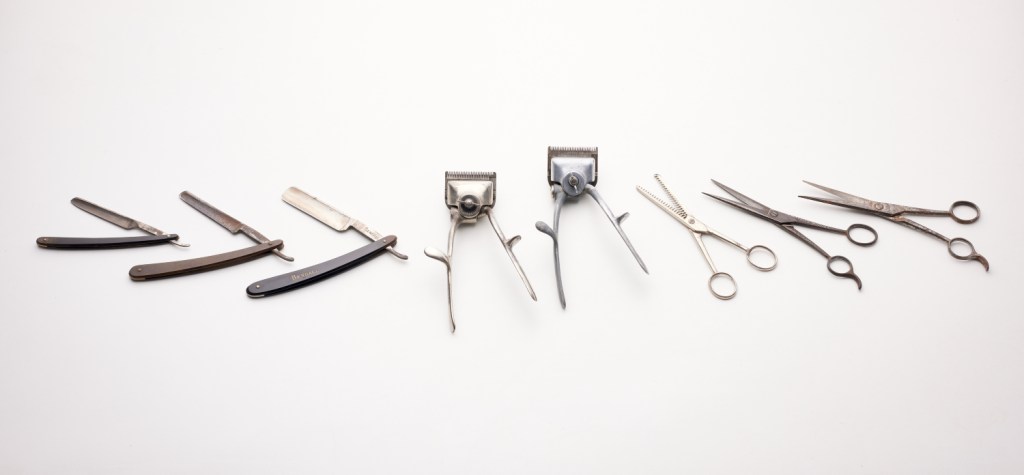
…two chairs, the one you got , that was mine, and uncle would be cutting, I would get the other one ready, put the cloth around him, the towel and everything…and then when he’s finished that fellow, he’d come over to this fellow and just start cutting straight away, whereas I start, with that one, brush all the loose hair off them, put hair oil on and comb his hair and everything, and get the next one ready…I’ll do it with clippers and he would finish it off with scissors, see because scissors is the hardest part…because with scissors you’ve got to follow the comb. If you slip off above or below, that means a step cut out, and once you’ve cut a step out you cannot put the hair back…

…in that photo you had, uncle’s using the hand clippers because that fellow refused [electric clippers], he was frightened of getting electrocuted, he wasn’t used to it…
John married a local girl, Winifred Hurman, in 1937. During the Second World War, John enlisted with the army. He never saw active service as he was asked to remain at the Beaudesert training camp as the base’s hairdresser. He had taken some of his barber’s equipment with him, and many soldiers were told to go to him for a haircut.
… after each parade, Captain Bates…used to tap the soldiers on the shoulder, ‘that’s the one to get a haircut, that’s the one’, the Sargeant going behind him writing the names down. Right after the parade I had a little place like this in the barracks, specially for cutting hair, all them fellows lined up, get a short haircut…
After the war John continued to work at his uncle’s shop. Following the death of his uncle in 1954, he ran the business until his aunt died in 1968. John relocated the business to Wynnum, and then to Manly. After being fined a few times for cutting hair after 5pm, he closed his shop in 1972 and delivered gas cylinders for Porta-Gas for a few years. On weekends he continued to cut hair in a room at his house until the Soldatenko collection was acquired by Queensland Museum in 1996.


A selection of items from the Soldatenko Collection. Photographers: Bruce Cowell and Lee Wilkes. 
A selection of items from the Soldatenko Collection. Photographers: Bruce Cowell and Lee Wilkes. 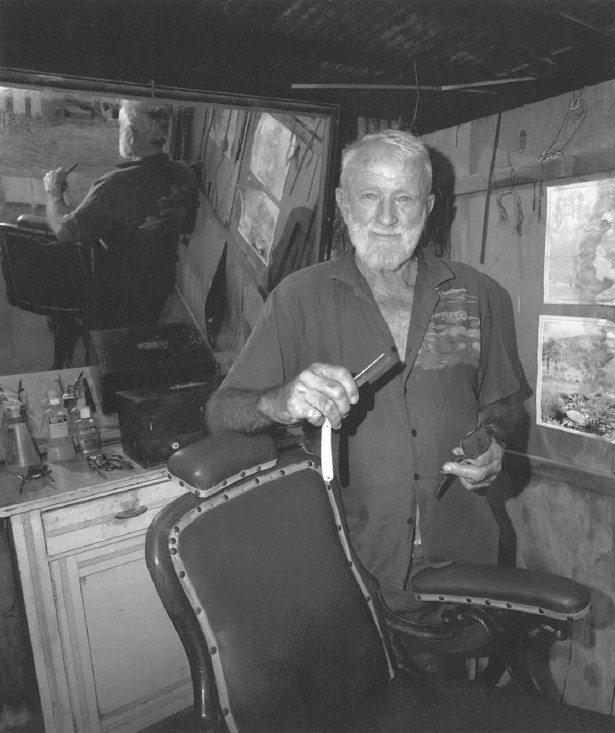
A selection of items from the Soldatenko Collection. Photographers: Bruce Cowell and Lee Wilkes. 
A selection of items from the Soldatenko Collection. Photographers: Bruce Cowell and Lee Wilkes. 
A selection of items from the Soldatenko Collection. Photographers: Bruce Cowell and Lee Wilkes. 
A selection of items from the Soldatenko Collection. Photographers: Bruce Cowell and Lee Wilkes. 
A selection of items from the Soldatenko Collection. Photographers: Bruce Cowell and Lee Wilkes.



 Queensland Museum Blog
You must be logged in to post a comment.