

By Dr Jenny Beard and Dr Owen Seeman, Queensland Museum
Did you know Australia is home to one of the greatest diversity of flat mites (Acari: Tenuipalpidae) in the world? More than one-third of all known flat mite genera are found only in Australia, making them an important part of our unique biodiversity.
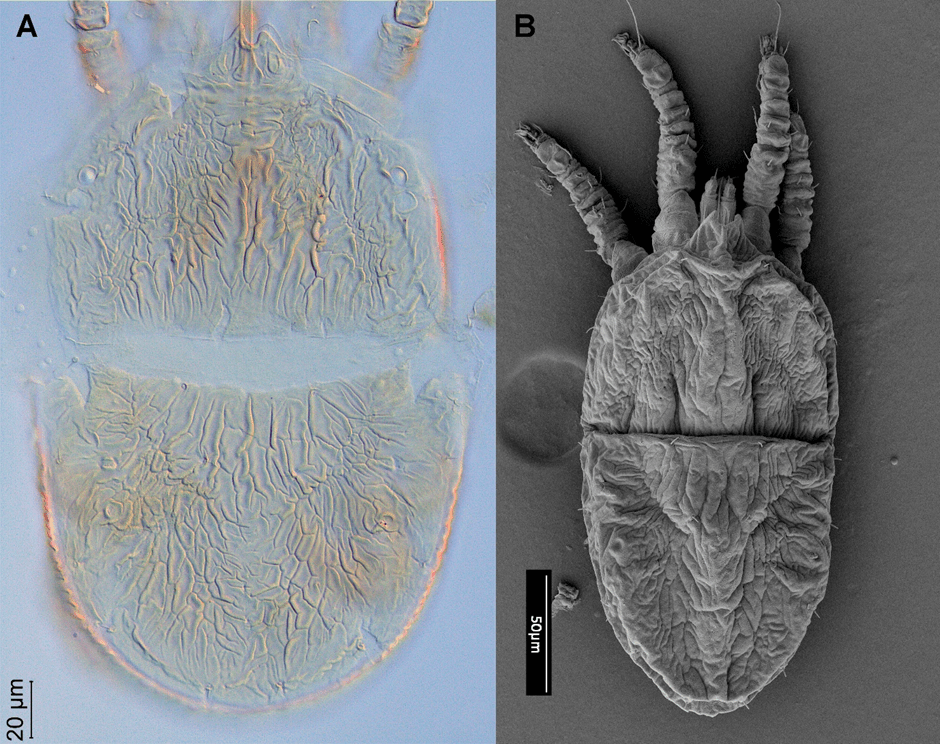
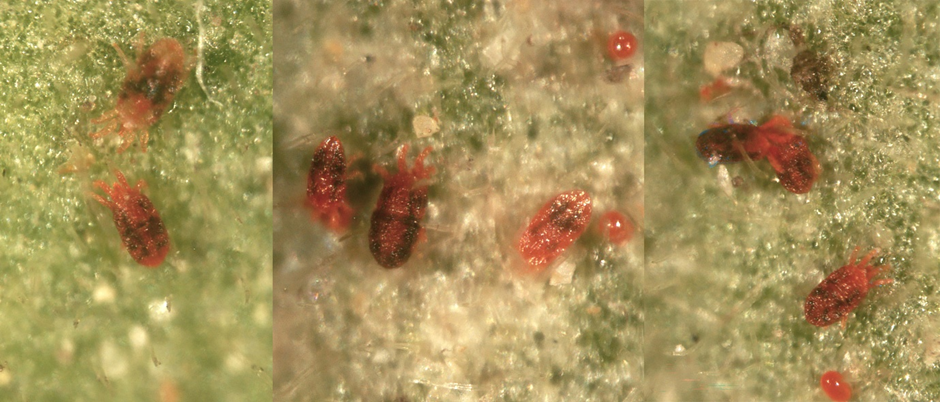
Recent research at Queensland Museum has uncovered an entirely new radiation of flat mites on the Goodeniaceae, a family of plants found mostly in Australia and Papua New Guinea. From just five species of Goodeniaceae, we have already identified three new genera and eight new species of flat mites – all tiny, bright red creatures that are almost invisible to the naked eye. When we say tiny, we mean tiny – you would need to line up 4 or 5 mites in a row to make 1 mm!
Flat Mites and Their Australian Plant Hosts
Aussie flat mites are fascinating because many of their lineages are tightly linked to our distinctive native plant families. Our previous research has shown unique radiations on families such as the Casuarinaceae, Myrtaceae and Cyperaceae. Now, we’ve added Goodeniaceae to the list.
So far, we have described:
- Bauchania – two new species found on Dampiera sylvestris (blue Dampiera) and Goodenia bellidifolia (daisy Goodenia).
- Goodeniacarus – a new genus with several species living on Goodenia glabra and Goodenia grandiflora.
- Inglacarus – another new genus discovered on Goodenia rotundifolia.
This research was made possible with funding from Bush Blitz through a Taxonomy Research Project (Beard & Seeman 2025).
Given that the genus Goodenia includes around 200 species, it is likely that many more flat mite species are waiting to be described.

Surviving in Tough Australian Environments
Unlike other plants that host flat mites, many Goodenia species grow in arid or semi-arid regions. They sprout after rain, then die back, often leaving no leaves for months at a time. For a tiny mite that depends on leaves, that could be a problem.
But these mites seem to have an extraordinary survival strategy. On a 2022 Bush Blitz expedition to Rungulla National Park, we found only a few mites hanging out on the leaves of their host Dampiera adpressa. However, the plant’s roots were teeming with mites.
Root feeding is almost unheard of in flat mites – only two species worldwide have been documented doing this before (Capedulia calendulae in South Africa and C. maritima in Israel). This suggests that Australian flat mites may have evolved to survive on roots when leaves are unavailable, giving them an advantage in dry, unpredictable environments.

Why does this matter?
Documenting new-to-science-species of mites is not just about naming tiny creatures – it’s about understanding Australia’s ecosystems and the hidden biodiversity that makes them so unique. Flat mites may be small, but they play important roles in their habitats, and their evolutionary links with plants tell us more about Australia’s natural history.
As research continues, Queensland Museum scientists expect to uncover many more mite species living quietly on Australia’s diverse flora. Each new paper and research project adds another piece to the puzzle of how life has evolved and adapted on this continent.

 Queensland Museum Blog
You must be logged in to post a comment.