
Written by Dr Liz Bissell, Senior Curator Queensland Stories; and Damien Fegan, Information Officer, Queensland Museum
The term synchronicity was coined by Carl Jung – the famous Swiss author, thinker, and psychologist – as “a meaningful coincidence of two or more events where something other than the probability of chance is involved.”
Synchronicity as a theme is particularly apt for museum curators because it is our job to connect people with objects and stories, across past and present.
Sometimes, these seemingly random interactions can take us by surprise.
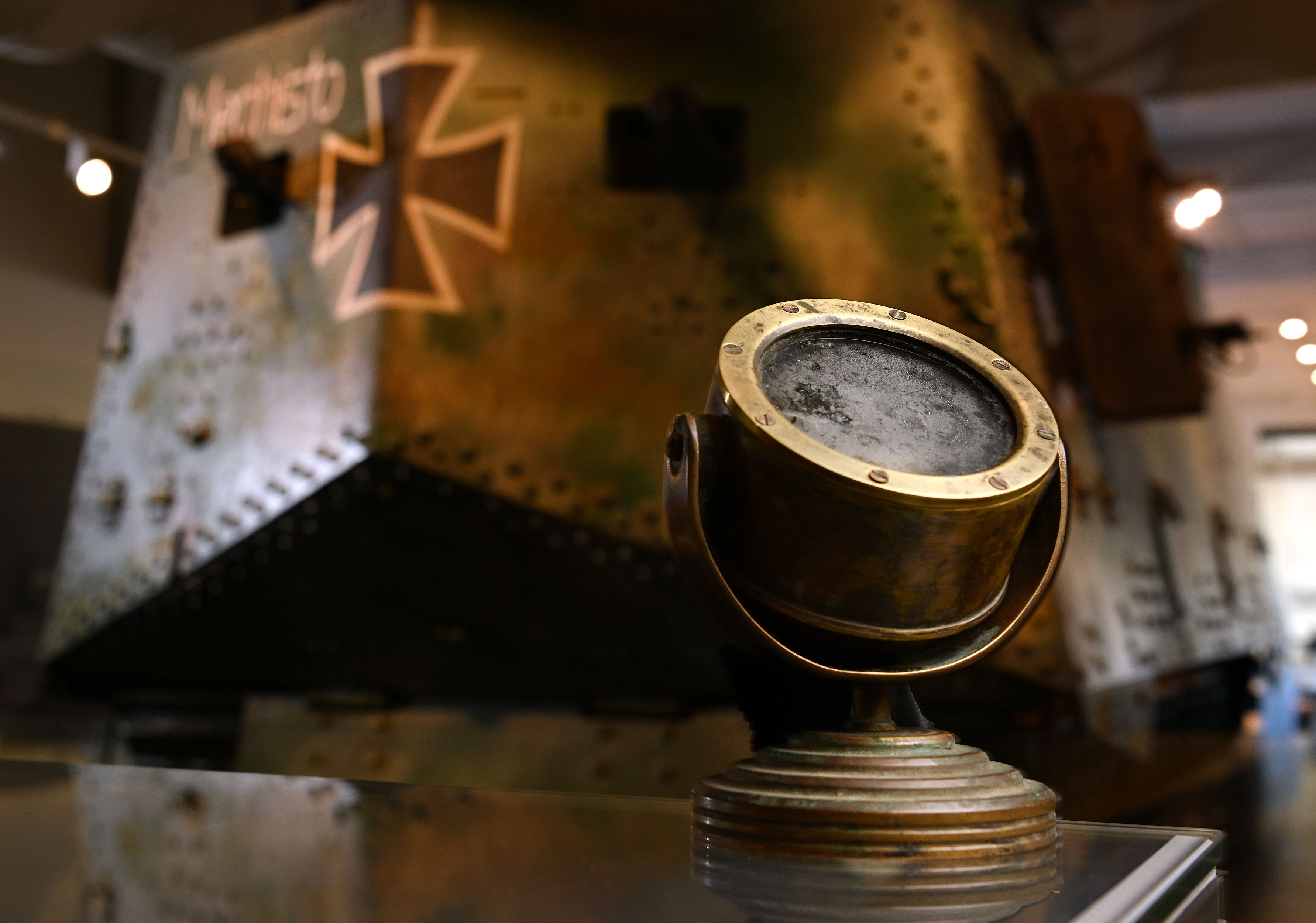
This was the case when we recently discovered a striking coincidence in relation to the compass believed to be from Mephisto donated by Tom Lamin in May 2023.
But first, some background.
Tom’s grandfather, Horace Warner Lynch, a World War I veteran, gave him a compass when he was around ten years old, telling him it was from ‘the captured German tank’. After being subjected to Tom’s boyhood experiments, including removing the original paint and several attempts to take it to pieces, the compass was eventually abandoned and sat in Tom’s garage for many years, gathering dust.
In August 2022 Tom stopped in at Queensland Museum on the way to Cairns for a holiday, saw Mephisto and left a message about the compass. This piqued the interest of Damien Fegan from the Museum Discovery Centre, who followed up with Tom over the course of the next few months, undertaking research into the provenance of the compass and the likelihood of it belonging to Mephisto.

Detective work
Damien contacted several experts and museums without much success until J.P. Donzey, curator of the online Compass Museum, was able to identify the compass as the product of either Carl Bamberg of Berlin or Carl Christian Plath of Hamburg. This was no ordinary compass, but a hi-tech fluid-filled, magnetic dampened compass capable of working when surrounded by tonnes of magnet attracting steel, such as in ship, U-Boat or, in this case, a tank.
Unfortunately, the archives of both companies were destroyed during the Second World War, as were the blueprints of the A7V tanks, so the only way to confirm the provenance of the compass will be to examine it for a maker’s mark.
Tampering at Tilbury Docks
So how did Tom’s grandfather come to have the compass?
Lt. Horace Warner Lynch survived three years in the trenches at Gallipoli and on the Western Front in France before being invalided to England with influenza in June 1918, three weeks before Mephisto was retrieved by a combined British-Australian operation. The official record shows Lynch on convalescent leave in London in early 1919 before being attached to 1st Infantry Brigade for repatriation, right next to Tilbury Docks where Mephisto also awaited transport to Australia.
So, we know that Lt. Lynch and Mephisto crossed paths, and we also know that it was very common for soldiers to ‘souvenir’ objects from the battlefield as personal mementos. His studies in engineering interrupted by the war, Lynch would likely have been very interested in what was then a hi-tech compass with the bonus that it was designed to be easily removed for calibration.
Decades after the war, in the 1960s, Horace Lynch passed the compass down to his grandson Tom, who later followed in his grandfather’s and father’s footsteps to become a mechanical engineer. After he retired, Tom started thinking about where the compass might have come from and discovered Mephisto.
The rest, as they say, is history.
A new direction
Since the national media coverage of Tom’s donation, visitors have been curious about where the compass is and when it will go on display.

The answer is that the compass is currently in Queensland Museum’s Conservation lab where it will undergo cleaning and conservation. It is hoped that once the fluid is drained and it is taken apart (successfully this time!), we will be able to see a maker’s mark and confirm its provenance as either a Bamberg or Plath magnetic dampened compass. Sadly, we cannot test to see if the compass fits, as one of the missing parts of Mephisto is the roof panel with the compass dome. Eventually, the compass will go on display in the Anzac Legacy Gallery alongside Mephisto.
Which brings us to synchronicity and the connectedness of all things.
Recently, Damien was speaking with a couple of visitors to the Anzac Legacy Gallery about Mephisto and, “as I was talking about the compass, an image scrolling on the video wall next to Mephisto struck me as familiar.” It was a photograph of Lt. Horace Warner Lynch from Queensland Museum’s Fred Port collection.

Out of the 330 000 + members of the 1st AIF who served overseas, Horace Warner Lynch appears in only one known official photo and, unknowingly, this was one of the photos chosen in 2018 to be shown on the wall next to Mephisto.
It appears that Lt. Lynch had been hiding in plain sight next to Mephisto for years without us knowing!
Mephisto, and what the tank represents, is part of Queensland’s social (and martial) identity. It speaks to Australia’s involvement in our first major armed conflict, the development of a distinctly Queensland identity, and the origins of the ANZAC legend. But it is the stories of the people connected with the tank, and the interpersonal resonances across space and time they create, that help us make meaning of human experience.


Visit the Anzac Legacy Gallery on Level 1 of Queensland Museum
Plan your visit to Anzac Legacy Gallery, open daily from 9:30am – 5pm, or explore it online with our Virtual Tour.


You must be logged in to post a comment.